Designed Stairs

Designed Stairs has the experience to design structural, open-riser staircases that are also beautiful works of contemporary art.

  • Site-built vs Shop-built Stairs

    The main distinction in the world of stair building and design is shop-built vs site-built staircases.

    Site-built stairs

    Carpenter building stairs onsite

    Site-built stairs are the result of parts and material being brought to the site uncut, then a tradesman using those parts to build a stair according to his design and skill level.

    One drawback to this procedure is that most site-built stairs place finished materials (kiln dried hardwoods) over standard framing material using screws and nails. Because the framing materials are pine and have a higher moisture content, this type of stair almost always loosens over the years, resulting in a squeaky staircase.

    Perhaps a more obvious drawback to the site-built method is that the quality and overall finish is dependent upon the skill and interpretation of the tradesman you hire at the site. The skills you need are not only the woodworking skills, but also the design skills to consider each intersection and connection. If you get a talented tradesman with extensive stair experience, you will probably get a good stair. If you don’t hire the best tradesman, your results will usually be disappointing. There are few experienced stair experts available to build a site-built project. The best, honest assessment, is that there is risk involved.

    The cost factor

    In most cases, we find a perception or assumption that building on site will cost less. The labor and material costs are mixed in with other labor and material, so a true cost is never known. Even if the labor rate is less, the lack of expertise and slower install along with paying for any rework or problems along the way will likely exceed the cost of hiring an experienced stair company.

    Shop-built stairs

    Shop-built stairs in process

    • Are usually well-thought-out projects supported by accurate framing dimensions taken at the site, detailed shop drawings, and professional woodworkers.
    • Start with a more intentional design process. The components fabricated in the shop are produced to exacting tolerances on woodworking machinery run by professional woodworkers.
    • Use milled techniques for stringer, tread, and riser assembly that will maximize strength and ensure decades of squeak-free use.
    • Should provide you great budget control by locking in the price up front and knowing your end costs.

    Pro tips

    Visit the shop to see their quality and shop environment, and to verify the experience and skill-level of their craftsmen. An experienced stair company will always provide you with a superior product compared to site-built stairs.

    No matter who you hire to build your stairs, you should scrutinize their history, integrity, and abilities, as there will always be good and poor performers out there.

  • Trending Stair Styles

    Are you are looking for a one of a kind look to create that WOW factor as you walk into your home?

    Gold is back — glamorous and bold. Metal suppliers are now offering gold finishes, so we can offer an affordable custom look without the additional cost to custom finish.

    Get creative with a custom milled stair personalized for your client’s specific design.

    Black is here to stay — bold and beautiful paired with white for an elegant finish.

    Minimal lines are huge right now. “Less is more” is definitely what people are looking for.

    Staining an elegant wood rail black or a dark stain can give you a softer elegant look.

    Using iron throughout creates beauty and elegance, bringing a warmth to your home with a contemporary style that will last for years to come.


  • Luxury Staircases Across America — What might surprise you

    Having had the opportunity to work on Luxury stair projects from coast to coast, we have been intrigued by the vast differences in design and construction from one region to another.

    The greatest distinction is shop-built versus site-built. Shop-built stairs are typically milled staircases made by companies that specialize in stairs. They design and build custom hardwood staircases in a shop environment, then transport to the jobsite for installation. The term “milled” staircase refers to the fact that the stringers are milled, or routed. The treads and risers are wedged and glue blocked into the stringers. Most milled staircase builders have their roots in the tradition of European joinery and staircase techniques.

    The East Coast through Pennsylvania, Ohio, and on to Chicago have the highest concentration of milled staircases. Atlanta, Denver, Seattle, and South Florida have some noted stair specialists as well.

    The West Coast and Southwest frequently use masonry stairs over-laid with tile. Since most of this work is done at the job-site, the quality varies greatly from site to site and craftsman to craftsman. Although many of these site-built jobs turn out well, there’s always risk.

    There are vast areas of the country where stair companies are not located, and therefore milled staircases are not available. Throughout much of the country, staircases are framed at the site with standard framing material, and trim carpenters overlay hardwoods and stair parts to finish the job. This can present any number of problems, from squeaks to joint quality issues. It’s never easy to cover up framing with hardwood.

    As in most things in life, if quality is what you are after, it’s best to find a highly skilled professional who has specific experience with the task at hand.

    If you are interested in the finest milled staircase, please contact us with your print or job site information. We are happy to help you — throughout the USA.

  • Getting the Most from Your Stair Dollar — Material

    Part 4 of 4

    Materials in stock are less expensive — e.g., red oak is the most common hardwood and among the least expensive.

    As with styles, components made from wood species that are stocked will always cost less than custom orders. We have noticed a trend over the past eight to ten years to natural or brown toned species such as walnut and white oak. Within the United States, red oak is the most common hardwood and consequently, one of the least expensive.

  • Getting the Most from Your Stair Dollar — Shape

    Part 2 of 4 — Shape

    In the last blog, Getting the Most from Your Stair Dollar (Part 1), we introduced the three basic factors to keep in mind when thinking of your stair budget. Here we’ll explore the first of those three factors: Shape.

    A straight stair is the least costly and also takes up the least amount of space. The money saved on a straight stair could be used to upgrade your railing style or material.

    A landing stair will cost more due to the landings themselves and the added newels and rail intersections.

    Winder stairs are more expensive than landing stairs due to the installation of winder treads, winder newels and rail intersections. Winder stairs may also be subject to restrictive building codes. Check with your local building department.

    Curved staircases are the most expensive due to the handmade nature of the components.

    Straight stairs
    Straight

    Straight stairs
    Landing

    Straight stairs
    Winder

    Straight stairs
    Curved

  • Getting the Most from Your Stair Dollar

    Part 1 of 4 — Overview

    Milled stairs may cost from $2,000 for a hardwood stair with wall rails, to $200,000 on the high end.  Most of us are shopping in the $5,000–20,000 range.

    When designing your stair and railing plan, there are three basic factors to keep in mind in order to use your budget wisely: shape, style, and material.

    If you have the luxury of starting from the general shape of your stair (new construction in the blueprint design stage) consider the shape first.  If your space/shape is already defined, it may limit controlling that aspect of your budget, but there are still two aspects to consider.

    Which is more important to you: style or material?  If are you are dead set on walnut, you may need to look at mixing it with stocked poplar parts for balusters and newels. If you have a style you are set on, such as stainless cable, most of your budget will go to that, and you may consider a simpler oak stair.

  • Should painted balusters be installed at the same time as the stair?

    Painted balusters

    If you are buying a stair with balusters in a contrasting material, such as painted balusters on an oak stair, questions will likely arise regarding the finishing of the stair. “Should my painter finish the balusters separately from the stair, then have the balusters installed when the stair is finished?

    Here are some things to consider:

    • Your painter will generally opt for painting the balusters before installation. This allows them to be sprayed instead of brushed and eliminates a lot of “cut-in” work.

    • Painting balusters separately also means that the stair installers will have to come back to the site, remove the railings and install the balusters. There will be charge for this “second trip” to the jobsite. You will have to remember to schedule this “second trip” in coordination with the completion of the finish.

    • Leaving your balusters out for painting means that they are more likely to be lost or stolen during this time. You will be responsible for balusters left at the jobsite.

    • Once the painted balusters are finally installed, there will be additional “touch-up finishing required at the rail joints. Holes will have to be filled and stain and finish re-applied for the final finish.

  • Curb Appeal Moves Indoors

    Entry stair as viewed from front door

    We often talk curb appeal the first thing a prospective home buyer sees. Real Estate professionals say a buyer makes up their mind if they will buy a home in the first 3 minutes of walking through your front door. So how important are the stairs just inside your front door?

    • The entry sets expectations for what your visitor will experience in the rest of your home.
    • It is the first and last impression you make to your guests.

    Designer kitchens and baths have become the ‘foundation’ of value in a home. Once that foundation is built. The entry and stair is the next logical step. At times we may decorate all our rooms, and treat our entry as a ‘walk through’, not giving full decorating attention. Treat it as a room. Decorate it with furnishings as you would any other room. The natural focal point of the entry is the stair. It sets the tone for the room. Increasing the WOW of your entry will not only create a more inviting welcome for your guests, it will enhance the marketability of your home.

  • Curved Assembled Stairs

    Curved Assembled Stairs

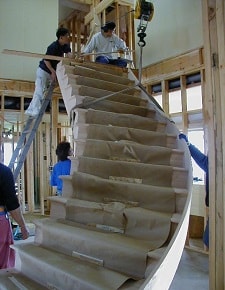
    At Designed Stairs we rate the difficulty of installation on a scale of 1 to 5, with level 1 being the simplest to install for a good trim carpenter, and level 5 requiring the highest level of stair installation specialist. Most often, curved stairs are categorized as level 1 or level 2. This makes assembled curved stairs a great option for some builders. We take care of the designing and building processes, and your trim carpenters take care of the installation.

    Here’s how it works:

    We start by looking at the plans to determine if assembled stairs will work for the specific project.  It is important to consider things like the shape and configuration of the stairs, if they will fit through the door assembled, among other factors. 

    Our technicians and engineer fine tune the stair’s design for the final product to flow beautifully as one piece, considering any transitions between multiple radii on the stringers and rails. 

    We can provide framing details for the walls around the stairs as needed to make sure that the stairs will fit precisely on site.  We then build this same framing on the decks at our shop to build the stairs and fit the rails to.  Once completed, the stair is taken down in one piece and the rail in a separate piece for delivery.  Delivery is provided by Designed Stairs throughout our standard service area (all of Chicagoland, NW Indiana, and SE Wisconsin) and by common carrier elsewhere. 

    Once the stair is on site, installation is very straightforward, and we provide any instructions needed.  Since the stair is in one piece, it only needs to be fit at the header and the rest will fall into place.  At this point, the curved walls around the stairs can be framed.  Once newels are fit, rails can be installed quickly since they are already fit to the stair. 

    For more complex stairs, we offer full installation throughout the Chicagoland and installation training or assistance by one of our level 5 skill installers in any location.  This is a great option if you have a highly skilled trim carpentry team that just needs some specific direction. 


    /

    /

    /

  • How to Fix a Squeaking Stair

    A squeak in a stair is generally caused as the lumber dries out over time. Hardwoods are regulated by industry standards for a moisture content of 6-8%. This matches the moisture content inside the average home and allows the wood to remain stable under normal conditions.

    Pine (grades used for basement stairs and stairs to be fully covered with carpet) has a typical high moisture content of 12-16%. Over time as pine shrinks built stairs will begin to squeak.

    If your stair is squeaking, check the humidity level in your home as a first step. Verify where the squeak is coming from. You may hear a squeak walking up the stair, but it could be coming from the framing material rubbing against the stair, and not the stair itself.

    Tools to fix a squeaking stair

    How to Fix

    You can typically fix the squeak, as simply as “toe nailing”* a long nail or two in the area that is squeaking. That is not to say more squeaks won’t develop over time, as the lumber continues to dry out to equal the humidity level of your home.

    *Toenailing: driving a nail at an angle into a board. It makes a strong joint while it also pulls joining boards into position.