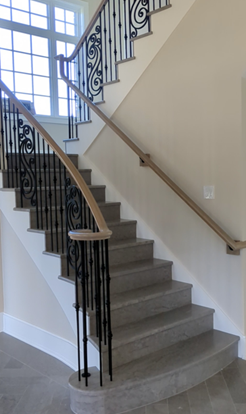
Designed Stairs

Designed Stairs has the experience to design structural, open-riser staircases that are also beautiful works of contemporary art.

  • Red Oak versus White Oak

    red-oak-versus-white-oakRed oak (quercus rubra) is far more plentiful in all hardwood markets than White oak (quercus alba), and therefore, will be less expensive in every aspect. Red oak usually has a pinkish hue and distinct “tiger stripes” in the surface grain, while white oak tends to a light brown coloration with less distinctive grain patterns. While both woods are extremely strong, white oak has a greater density, more strength, and can be used for liquid containing barrels, ship building and exterior products, while red oak is confined to interior use, such as cabinets, staircases, trim and furniture. Historically, white oak has been used in fine woodworking applications that indicate a higher-end product. The dense grain of white oak would have a practical advantage over red oak when used in bathroom and kitchen floors, where moisture would be expected.


    The vast majority of stocked stair parts are red oak and white oak is very likely to be a custom order. Since the raw material of white oak is more expensive and White oak parts are generally custom ordered, a white oak staircase will cost more than a red oak staircase.

  • Glass Treads

    An important consideration when designing any space is the presentation and distribution of light.  This is especially true when considering a staircase, since the available light will have a direct effect on safety.

    We recently completed a project where we were presented a design for a contemporary home with a staircase featuring glass treads.  The architect had a very specific design in mind, featuring a welded steel structure that would support structural, textured glass treads wrapped in a wood frame.  Our head design technician ended up working directly with the architect to verify each detail and maximize the efficiency of the fabrication process.

    The glass treads are very effective for the vision the architect had in mind.  Light is able to pass through from above to light the basement stairs during the day, and from above and below at night.  The glass, wood, and steel design is clean and ahead of its time.

  • Library Spiral Staircases

    A spiral staircase is the most compact stair design.  Spiral stairs have a center support post, a landing deck at the top and usually have a diameter of 48″ to 96″.  The small size of a spiral allows it to fit into corners and service lofts, attics and other secluded areas where traffic will be light. 

    Spiral stairs are not generally allowed as primary staircases, so there will need to be code compliant stairs elsewhere in the building.  For example, most current building codes do not allow the individual rise of a stair to exceed 7.75″, whereas a spiral stair may have an individual rise of up to 9.5″.

    The floor space allowed for a spiral stair should always be at least one foot larger than the planned diameter of the stair. If you plan to have a 60″ (5 ft.) diameter spiral, you will need to have a 72″ x 72″ (6 ft. x 6 ft.) floor space.

    Due to the compact nature of a spiral staircase, they have become widely used in library environments where space is limited and access to upper book storage is necessary.  Many of the libraries that we have worked on utilize a spiral stair to the upper loft area and rolling library ladders to access the upper shelves on level surfaces.  A high quality, custom made spiral staircase will cost $13,000 – 20,000 depending on the height and amount of guardrail needed at your upper level.  A custom-made rolling library ladder can be budgeted in the range of $3,000 – 6,000.

  • Curved Stairs with Stone Treads

    Curved Stairs with Stone Treads

    A curved staircase has been an architectural highlight for centuries. While the geometries of curved staircases are all closely related, the fit and finish options are virtually unlimited. Let’s take a look at the use of stone treads overlaying a wooden stair structure. Of all available building materials, nothing presents a timeless feel more than a stone surface.

    The first difference in using stone treads versus wood treads is that the stone is set onto the stair from above versus being built into the stair.

    The second difference is that wood treads are still needed to support the stone, and they must be set lower than the finish surface calculated for the stair. Once the stone is set, you then have the correct surface heights for each tread.

    Since woodwork and stone work are not done by the same craftsmen, coordinating the design with each company can be the most difficult part of the project. Using a professional stair company or experienced stair builder to build the staircase is very important with stone elements. Special structural considerations may need to be made, taking into account the added weight of the stone. Strict tolerances help ensure a quality outcome. Trying to rough frame the stair almost always produces inaccuracies and variances in the structure that will come back to haunt you in the final fit of the finish material. The stair builder would build the curved stair, taking into account the thickness of the stone you have selected. Once the stair is installed, your stone contractor would come to the site to take their own measurements. Once the stone is precisely cut at their shop, they will return to install it and drill any holes that may be required. Then the stair contractor would return after the stone is set to install the railing system over the top. The added cost and labor on this project will warrant careful considerations and attention to detail. This is one case where your choices will be set in stone.

  • Trending Stair Styles

    Are you are looking for a one of a kind look to create that WOW factor as you walk into your home?

    Gold is back — glamorous and bold. Metal suppliers are now offering gold finishes, so we can offer an affordable custom look without the additional cost to custom finish.

    Get creative with a custom milled stair personalized for your client’s specific design.

    Black is here to stay — bold and beautiful paired with white for an elegant finish.

    Minimal lines are huge right now. “Less is more” is definitely what people are looking for.

    Staining an elegant wood rail black or a dark stain can give you a softer elegant look.

    Using iron throughout creates beauty and elegance, bringing a warmth to your home with a contemporary style that will last for years to come.