Designed Stairs

Designed Stairs has the experience to design structural, open-riser staircases that are also beautiful works of contemporary art.

  • Stair Quality Across the US

    Traditional European stair-building methods were transferred to the US along with immigrant craftsmen in the early years of our country’ history. The Great Depression caused the stair-building arts to almost disappear. The resurgence of the two-story home in the 1950’s and 60’s caused stair-builders to spring up in most major metropolitan areas across the country with a concentration from New York to Chicago.

    The highest concentration of traditional full-milled stair shops remains in the Midwest, with Chicago being one of the most concentrated markets.

    The popularity of the stair trade in the Midwest is partly due to the strong tradition of the open staircase in single family homes. Farm house style and a strong urban element from historic Chicago architecture have combined to create high standards in the role of the open staircase. As with all free-market supply and demand, the importance of the open staircase in the Midwest has fed the strength and development of the stair industry to perhaps the highest level in history.

    The strong background and tradition of the stair trade has been boosted by CNC technologies, to bring design and quality to new levels. This also means that the average Midwest home is able to have stair and rail designs that may be out of the question in other regions of the country.
  • Helping Your Customer Be at the Right Price Point

    Helping Your Customer Be at the Right Price Point

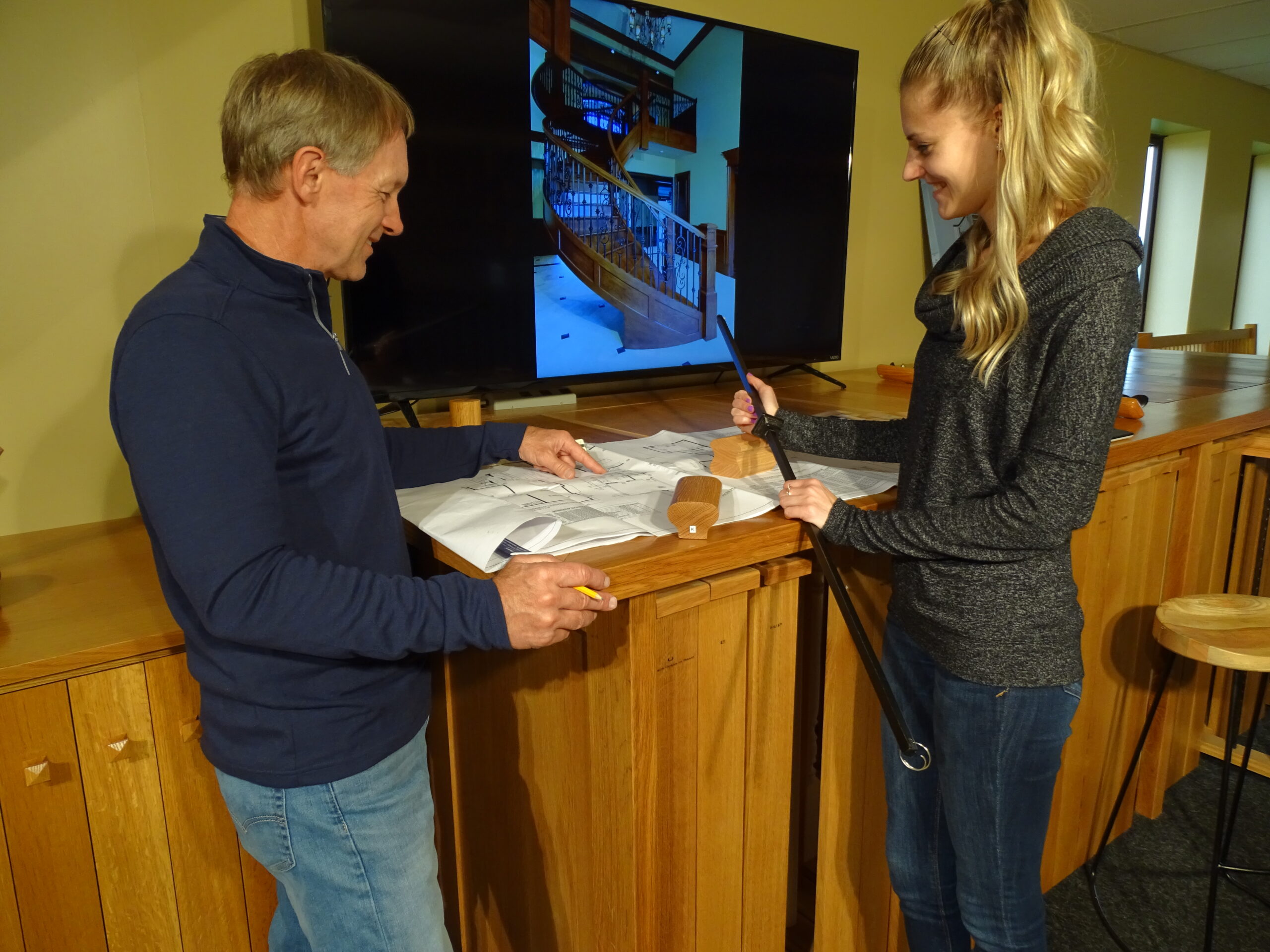
    One of the first conversations we have with our clients is to establish a budget. It can be a delicate conversation that must start on the foundation of trust. Without some direction, we are often headed into a long and painful process.

    If our client does not have a budget in mind, we help them by making budgeting suggestions. These suggestions are based on their home value and the portion typically spent on a stair project. Once we give them a range and get some feedback, we can start working toward a budget range. Homeowners are generally more comfortable at this point, knowing that they can end up where they want to be budget-wise.

    Once we have a range, we can start looking at concepts of stair styles and discuss features and costs to help steer them into the range they are comfortable spending. If the concepts tend to be well beyond their budget, then we can find designs that work within the budget.

    There is so much that we can offer, as long as there is a willingness to be flexible. We can find a fabulous solution that works great in the space and fits the budget.

    Although we offer full-service design assistance, working with a professional Designer gives clients the reassurance that you have the experience and knowledge needed to make wise decisions on their behalf.

    Clean lines are very popular right now. Below is a broad example of projects that represent many different price points, but all achieve an overall clean look.

  • Trending Stair Styles

    Are you are looking for a one of a kind look to create that WOW factor as you walk into your home?

    Gold is back — glamorous and bold. Metal suppliers are now offering gold finishes, so we can offer an affordable custom look without the additional cost to custom finish.

    Get creative with a custom milled stair personalized for your client’s specific design.

    Black is here to stay — bold and beautiful paired with white for an elegant finish.

    Minimal lines are huge right now. “Less is more” is definitely what people are looking for.

    Staining an elegant wood rail black or a dark stain can give you a softer elegant look.

    Using iron throughout creates beauty and elegance, bringing a warmth to your home with a contemporary style that will last for years to come.


  • Getting the Most from Your Stair Dollar

    Part 1 of 4 — Overview

    Milled stairs may cost from $2,000 for a hardwood stair with wall rails, to $200,000 on the high end.  Most of us are shopping in the $5,000–20,000 range.

    When designing your stair and railing plan, there are three basic factors to keep in mind in order to use your budget wisely: shape, style, and material.

    If you have the luxury of starting from the general shape of your stair (new construction in the blueprint design stage) consider the shape first.  If your space/shape is already defined, it may limit controlling that aspect of your budget, but there are still two aspects to consider.

    Which is more important to you: style or material?  If are you are dead set on walnut, you may need to look at mixing it with stocked poplar parts for balusters and newels. If you have a style you are set on, such as stainless cable, most of your budget will go to that, and you may consider a simpler oak stair.

  • Curved Assembled Stairs

    Curved Assembled Stairs

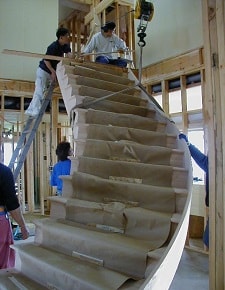
    At Designed Stairs we rate the difficulty of installation on a scale of 1 to 5, with level 1 being the simplest to install for a good trim carpenter, and level 5 requiring the highest level of stair installation specialist. Most often, curved stairs are categorized as level 1 or level 2. This makes assembled curved stairs a great option for some builders. We take care of the designing and building processes, and your trim carpenters take care of the installation.

    Here’s how it works:

    We start by looking at the plans to determine if assembled stairs will work for the specific project.  It is important to consider things like the shape and configuration of the stairs, if they will fit through the door assembled, among other factors. 

    Our technicians and engineer fine tune the stair’s design for the final product to flow beautifully as one piece, considering any transitions between multiple radii on the stringers and rails. 

    We can provide framing details for the walls around the stairs as needed to make sure that the stairs will fit precisely on site.  We then build this same framing on the decks at our shop to build the stairs and fit the rails to.  Once completed, the stair is taken down in one piece and the rail in a separate piece for delivery.  Delivery is provided by Designed Stairs throughout our standard service area (all of Chicagoland, NW Indiana, and SE Wisconsin) and by common carrier elsewhere. 

    Once the stair is on site, installation is very straightforward, and we provide any instructions needed.  Since the stair is in one piece, it only needs to be fit at the header and the rest will fall into place.  At this point, the curved walls around the stairs can be framed.  Once newels are fit, rails can be installed quickly since they are already fit to the stair. 

    For more complex stairs, we offer full installation throughout the Chicagoland and installation training or assistance by one of our level 5 skill installers in any location.  This is a great option if you have a highly skilled trim carpentry team that just needs some specific direction. 


    /

    /

    /