Designed Stairs

Designed Stairs has the experience to design structural, open-riser staircases that are also beautiful works of contemporary art.

  • Helping Your Customer Be at the Right Price Point

    Helping Your Customer Be at the Right Price Point

    One of the first conversations we have with our clients is to establish a budget. It can be a delicate conversation that must start on the foundation of trust. Without some direction, we are often headed into a long and painful process.

    If our client does not have a budget in mind, we help them by making budgeting suggestions. These suggestions are based on their home value and the portion typically spent on a stair project. Once we give them a range and get some feedback, we can start working toward a budget range. Homeowners are generally more comfortable at this point, knowing that they can end up where they want to be budget-wise.

    Once we have a range, we can start looking at concepts of stair styles and discuss features and costs to help steer them into the range they are comfortable spending. If the concepts tend to be well beyond their budget, then we can find designs that work within the budget.

    There is so much that we can offer, as long as there is a willingness to be flexible. We can find a fabulous solution that works great in the space and fits the budget.

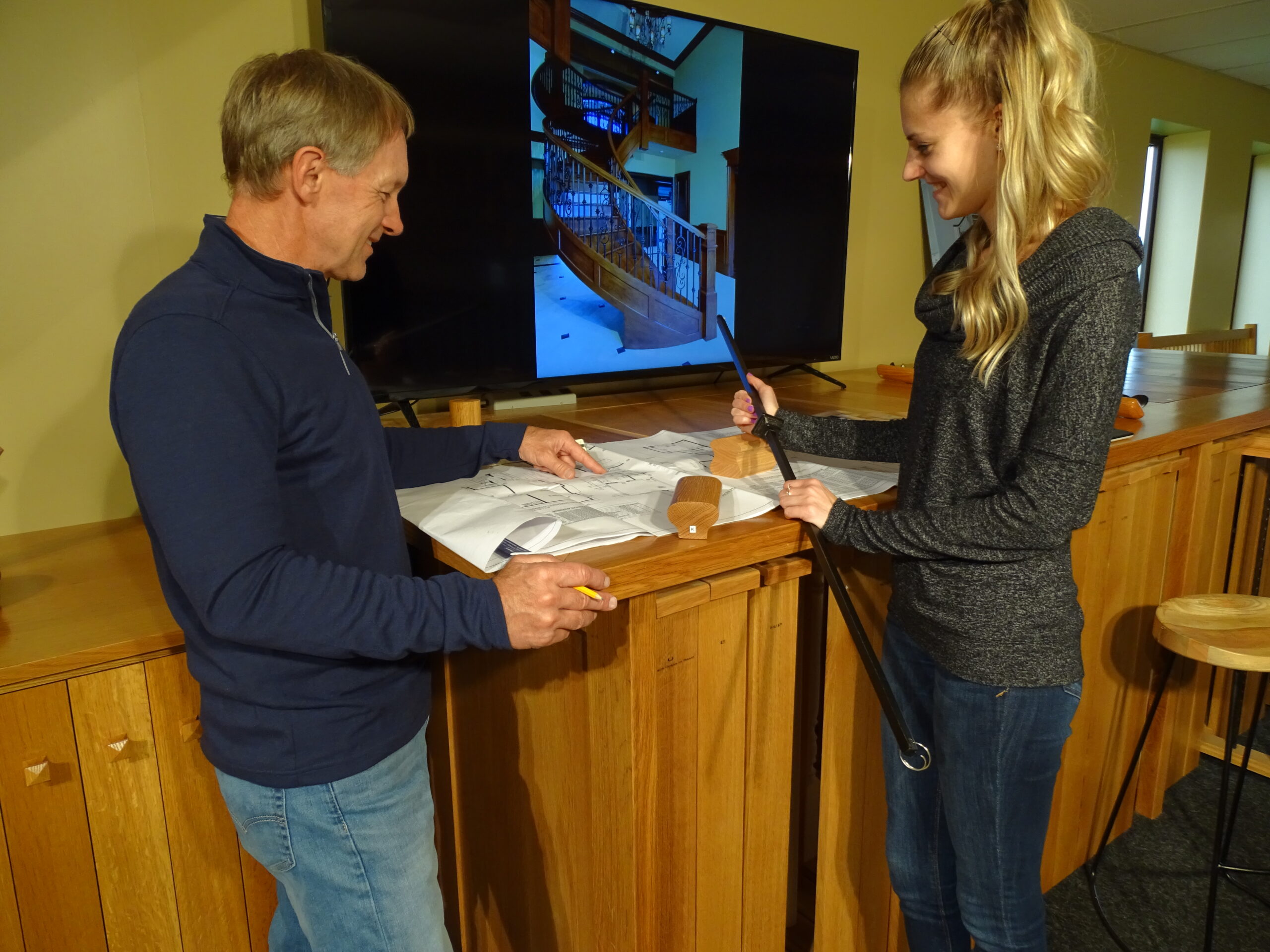
    Although we offer full-service design assistance, working with a professional Designer gives clients the reassurance that you have the experience and knowledge needed to make wise decisions on their behalf.

    Clean lines are very popular right now. Below is a broad example of projects that represent many different price points, but all achieve an overall clean look.

  • Trending Stair Styles

    Are you are looking for a one of a kind look to create that WOW factor as you walk into your home?

    Gold is back — glamorous and bold. Metal suppliers are now offering gold finishes, so we can offer an affordable custom look without the additional cost to custom finish.

    Get creative with a custom milled stair personalized for your client’s specific design.

    Black is here to stay — bold and beautiful paired with white for an elegant finish.

    Minimal lines are huge right now. “Less is more” is definitely what people are looking for.

    Staining an elegant wood rail black or a dark stain can give you a softer elegant look.

    Using iron throughout creates beauty and elegance, bringing a warmth to your home with a contemporary style that will last for years to come.


  • Getting the Most from Your Stair Dollar — Material

    Part 4 of 4

    Materials in stock are less expensive — e.g., red oak is the most common hardwood and among the least expensive.

    As with styles, components made from wood species that are stocked will always cost less than custom orders. We have noticed a trend over the past eight to ten years to natural or brown toned species such as walnut and white oak. Within the United States, red oak is the most common hardwood and consequently, one of the least expensive.

  • Getting the Most from Your Stair Dollar — Shape

    Part 2 of 4 — Shape

    In the last blog, Getting the Most from Your Stair Dollar (Part 1), we introduced the three basic factors to keep in mind when thinking of your stair budget. Here we’ll explore the first of those three factors: Shape.

    A straight stair is the least costly and also takes up the least amount of space. The money saved on a straight stair could be used to upgrade your railing style or material.

    A landing stair will cost more due to the landings themselves and the added newels and rail intersections.

    Winder stairs are more expensive than landing stairs due to the installation of winder treads, winder newels and rail intersections. Winder stairs may also be subject to restrictive building codes. Check with your local building department.

    Curved staircases are the most expensive due to the handmade nature of the components.

    Straight stairs
    Straight

    Straight stairs
    Landing

    Straight stairs
    Winder

    Straight stairs
    Curved

  • Stair Styles: What parts of my stair should I paint vs. stain?

    Painted newels

    All stained

    We often get asked the question: “What parts of my stair should I paint and what should I stain?” When determining what to stain and what to paint, think about the overall feel you want in your space. The more parts you paint, it will be a lighter and airier feel. The more parts you stain, it will be a warmer and richer feel.

    Here is a listing of the most popular groupings of what components to stain vs. paint:

    • All Stained: All Stained except balusters painted
    • Stained: treads, railing, newels. Painted: stringers, risers, balusters
    • Stained: treads and railing, all else painted

    Keep in mind that whether painting or staining, the colors you choose will make a profound design statement. A dark stain color complimented with a light (white) paint, will give a very elegant and formal look. While a colored paint, can give a very country or casual feel. Consider how elegant or casual the color and finish makes each stair. Scroll through stair photos and identify the overall feel you want in the color and visual weight of your stair. Darker colors (whether stained or painted) will make the space look more full and warm. Lighter colors, especially white, will give you a spacious and bright feel.

    You will likely be living with the your material and color selections on your stair for many years. Stairs and balustrades are not an easy item to strip or re-finish. If you are in doubt about your selections, call in a professional decorator. Your stair likely cost you thousands of dollars. For a few hundred dollars you can get professional decorating advise and proceed with confidence on your investment!

  • The Simple Beauty of Modern Stair Styles

    Modern design is simple, which is why it amazes me how many forms of modern styles have developed over the past 100 years. Modern stairs come in forms for all tastes and preferences. It can be the simplicity of a shaker style stair, or the stylistic design of a metal and glass stair. Modern styles can be organic or reflect modern technology.

    Modern

    Traditional modern

    Common themes of modern styling include:

    • Form Follows Function — the design should fill the need of the purpose
    • Simplicity and elimination of unnecessary details and ornamentation
    • Exposed Structure (as opposed to hiding the structural elements)
    • Truth to Materials — the material appears as it is naturally

    When planning your modern stair, consider the shapes your stair and rail create naturally. In the stair shown above, we merely accentuated the basic stair shape by adding visual weight to the rise and run of each step. The function of the stair itself creates its interesting lines.

    If you are starting with a traditional stair design, and want to make it modern, there are many modern style balusters and stair components that are readily available and will give you a great modern style. Nearly every material thought of can be used in used in modern styling — from wood to metal to glass. The options you have with modern design go as far as your imagination will carry you. See more custom stairs.

  • Setting Design Goals Helps to Select Your Stair Styles

    Buying a stair

    With the endless choices we have today, making the many decisions required for a building project can be overwhelming. It’s easy to make decisions based on “I like it”, but if that is your only criteria for selection, it is unlikely that you will end up with consistent design. Establishing design goals can help keep your selections on track for a fabulous end result.

    To establish design goals look through many magazines and find a dozen or more images of rooms you like. These are not rooms to copy, rather they are rooms that have a feel and look that you relate to; rooms you can see yourself living in. Select images of different rooms and even the exterior of homes you like. After you have a nice collection of photos, analyze them and understand what you like about them. Determine which images have a common thread of design elements that you like and discard any that are not in alignment.

    As you go through this process you will see your design evolve. It will change from a pile of beautiful pictures, to a clearer visual of the style you want to create. As you make each selection for your project, use your concept photos to guide you. You are not trying to copy them, but use them as a visual design compass. As you shop for trim, doors, cabinetry and stairs, ask yourself, does this selection fit into one of my concept rooms? Do they look like they all belong in the same house? Do the elements align?

    By keeping your concept photos close by and using them with each selection, you will end up with a much more unified design and an end result that aligns with your intentional goals for your project.