Designed Stairs

Designed Stairs has the experience to design structural, open-riser staircases that are also beautiful works of contemporary art.

  • Getting the Most from Your Stair Dollar — Material

    Part 4 of 4

    Materials in stock are less expensive — e.g., red oak is the most common hardwood and among the least expensive.

    As with styles, components made from wood species that are stocked will always cost less than custom orders. We have noticed a trend over the past eight to ten years to natural or brown toned species such as walnut and white oak. Within the United States, red oak is the most common hardwood and consequently, one of the least expensive.

  • Transforming Your Home by Installing a Hardwood Stair

    We get many calls where people no longer want carpet on their stairs and want to upgrade to a custom hardwood stair. What most people don’t realize is that stairs are a structural item. Stairs don’t come out easily. Replacing a stair is a real remodeling project and not just a decorating project.

    A first question is often “can you just leave in my stair and cover over it with hardwood?” In many cases we can (and sometimes we cannot). Realize there are down sides to covering an existing stair.

    Here is a short blog to explain some pros and cons to consider: Covering Stairs with Hardwood or Replace with New Stairs?

    Once you are committed to a stair replacement, here is an idea of what to expect. The old stair will be torn out and this usually means removing some drywall in the process. Consider hiring a contractor for the demo, new framing and drywall that is likely to be required. At times there are surprises at tear out such as plumbing, electric or duct work under the stair may need to be moved for a new stair design. If you are living in the house, schedule the tear out just a day or two before the new stair is installed. This will limit the time you do not have stair access to the 2nd floor. If you are not comfortable using a ladder for a day or two, consider sleeping elsewhere during the stair remodel. Once the new stair is installed, drywall has to replaced, taped sanded and painted. The stair will need to be stained/painted.

    Putting a new stair into your existing home will transform your home’s interior like few other things can.

    After hardwood stair replacement

    Before hardwood stair replacement

  • Curved Assembled Stairs

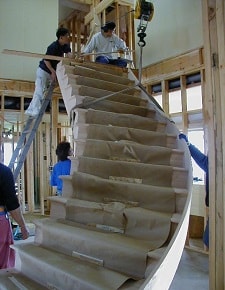
    Curved Assembled Stairs

    At Designed Stairs we rate the difficulty of installation on a scale of 1 to 5, with level 1 being the simplest to install for a good trim carpenter, and level 5 requiring the highest level of stair installation specialist. Most often, curved stairs are categorized as level 1 or level 2. This makes assembled curved stairs a great option for some builders. We take care of the designing and building processes, and your trim carpenters take care of the installation.

    Here’s how it works:

    We start by looking at the plans to determine if assembled stairs will work for the specific project.  It is important to consider things like the shape and configuration of the stairs, if they will fit through the door assembled, among other factors. 

    Our technicians and engineer fine tune the stair’s design for the final product to flow beautifully as one piece, considering any transitions between multiple radii on the stringers and rails. 

    We can provide framing details for the walls around the stairs as needed to make sure that the stairs will fit precisely on site.  We then build this same framing on the decks at our shop to build the stairs and fit the rails to.  Once completed, the stair is taken down in one piece and the rail in a separate piece for delivery.  Delivery is provided by Designed Stairs throughout our standard service area (all of Chicagoland, NW Indiana, and SE Wisconsin) and by common carrier elsewhere. 

    Once the stair is on site, installation is very straightforward, and we provide any instructions needed.  Since the stair is in one piece, it only needs to be fit at the header and the rest will fall into place.  At this point, the curved walls around the stairs can be framed.  Once newels are fit, rails can be installed quickly since they are already fit to the stair. 

    For more complex stairs, we offer full installation throughout the Chicagoland and installation training or assistance by one of our level 5 skill installers in any location.  This is a great option if you have a highly skilled trim carpentry team that just needs some specific direction. 


    /

    /

    /

  • Choosing a Hardwood for your Staircase: Wood Color

    Walnut for a traditional stair color

    There are several species of hardwoods that have very bold natural color, such as cherry, walnut, and mahogany. Historically these were the most desirable woods, due to their natural beauty and no need to stain or color them.

    These woods have long demanded premium prices.

    Other species of hardwoods may have more subtle color, but they still do have an underlying color that will be more apparent when the finish is applied. For example, red oak has a naturally pinkish hue; white oak is more neutral or slightly brownish. The same can be said of birch, maple and many other species. There are slight variations in their natural color. These woods tend to cost less than those species with a bold natural color.

    If budget constrains you, do not hesitate to buy a more affordable hardwood and stain it to look like a premium naturally colored hardwood. It’s no wonder most of the stain colors we buy at the paint shop have these naturally colored woods as their names. It allows us to mask other species to have their color.

    With all the stain choices we have today that are easy to use, wood color should not be your first design concern when selecting the wood for your stair. (See more on our Materials page.)

  • Cover Stairs with Hardwood or Replace with New Stairs?

    “I have ugly carpeted stairs, and I want the look of a nice hardwood custom made stair. Should I cover my existing stair with hardwood or replace with new stairs?”

    New Oak stair

    First consider how old your existing stairs are. If you have fairly new pine stairs under your carpet, the moisture content in your pine lumber will be higher than it will be in the hardwood. The woods dry differently. When a wood with a higher moisture content is covered with a dryer wood, it creates a high probability that it will develop squeaks.

    New wood stair

    Fitting hardwood stair parts to an existing stair can be laborious. There are about 30 pieces in a basic stair alone. This will likely result in over 100 cuts from prepping to installation. Keep in mind it’s harder to make a non-square cut to fit something existing than to make a good/new square cut.

    The cost of buying the hardwood stair parts will be essentially the same as buying parts for a new stair. The main difference is the labor of fitting them onto an existing stair or building a new stair. There may not be a savings to cover existing vs. a new stair.

    Last, but certainly not least is quality. A new custom built hardwood stair will likely have better joinery and fit. It allows you the opportunity to use new routed stringers and have your treads and risers tightly wedged into them. A method of measurably better construction.

    Price out both methods and compare all facts to make an educated cost decision.